Showing posts with label Best of Magnet Cat. Show all posts

6/7/09

Handmade Promotional Mailers


Here is my recently completed series of six handmade promotional mailers for Magnetic State. They are due to be shipped out to former and potential clients this week. Each one is unique. They were fun to make and I hope it shows!


5/25/09

Ten Great Art & Design YouTube Videos


Today I've selected ten art and design-related YouTube videos that I hope will inspire and entertain you. The subjects run the gamut from fine art and graphic design to graphic novelists, but they have one thing in common: serious ass-kickery. Enjoy.

Josef Albers: Homage to the Square


Here is a discussion of a painting (‘Aurora’) from Josef Albers’ ‘Homage to the Square’ series. I wish I could go back in time and take a class with the famed Bauhaus/Black Mountain master who believed that color was a “magic force.”

Paul Rand Interview


“Most good things have a timeless quality” according to designer Paul Rand, and this interview with him (on a hopelessly 80’s cable access program) is no exception. Rand is a hero of graphic design; his timeless work (logo designs for IBM, ABC, UPS) and no-nonsense, utilitarian approach to design can be seen here. Rand didn’t offer clients many choices for the solution to a logo design assignment “for the same reason that a doctor doesn’t give you a million choices – if you’ve got a headache, he’ll give you an aspirin. He doesn't give you a choice between that and Ex-Lax.” Visit YouTube to watch parts 2 and 3 of this interview with the coolest dude that ever did it.

Charles Burns in 'Fear(s) of the Dark'


This is artist Charles Burns’ entry in the animated French film ‘Peur(s) du Noir’ (‘Fears of the Dark’). Burns is responsible for Black Hole, the best graphic novel you’ll ever read. He uses his beautifully stark illustration style to tell Cronenberg-ian tales of love and lust that are dark, creepy, and usually populated with mutants. This film isn't available on DVD yet but this YouTube version will tide me over until it is. Visit YouTube for Part II.

Paula Scher: Great Design is Serious (Not Solemn)


Here is Pentagram partner Paula Scher’s speech ‘Great Design Is Serious (Not Solemn)’. Ms. Scher is refreshingly honest about the joys and disappointments of her career; she admits that some of her best work occurred in situations where she was “totally and completely unqualified for the job.”

Aesthetic Apparatus


The artists at the Milwaukee-based design studio Aesthetic Apparatus discuss their inspirations and processes. You know how every Criterion DVD release looks more beautiful than a cold beer on a hot day? These guys are one of the reasons why.

Jeff Koons Interview


Art is a “vehicle that creates anxiety.” Jeff Koons is interviewed here by the Tate Museum in his New York studio. If Warhol's studio was a factory, then Koons' place is an industrial complex. Out of all the museums whose YouTube channels I've browsed over the last week, the Tate's was the most watchable.

David Carson: Design, Discovery, and Humor


This is a quite funny and amusing speech given by David Carson, a graphic designer famous for breaking/ignoring a lot of rules in his work. “Don’t mistake legibility for communication,” he says here. “Just because something’s legible doesn’t mean it communicates; more importantly, it doesn’t mean it communicates the right thing.”

Matt Groening: 'My Wasted Life'


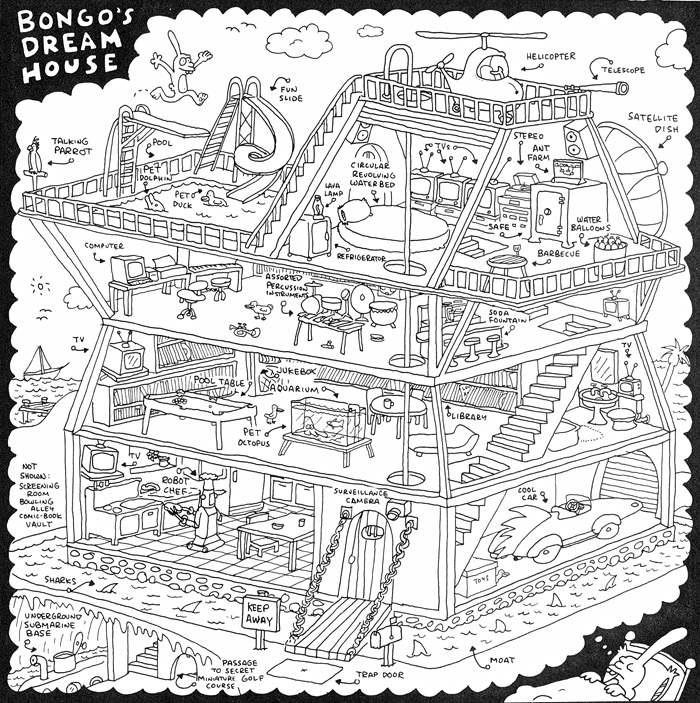
This is part one of a BBC program called ‘My Wasted Life’ about Simpsons creator Matt Groening. Groening recalls the sweet surreality of his own youth as well as the cultural roots of Bart and the gang. My favorite Groening comic: Bongo's Dream House.

Jenny Holzer: PROTECT PROTECT (Whitney Exhibit)


This video considers the politics of Jenny Holzer’s work on view in 'PROTECT PROTECT' at the Whitney Museum. Jenny Holzer has always been one of my favorites due to her skill at uniting image and word; the intersection of visual and literary arts has been a lifelong fascination for me. See the Whitney exhibit this week; its last day on view is Sunday, May 31st.

??????


Here is your new muse. Watch this video once a day and behold the wellspring of creativity that is sure to erupt from within your spirit.

4/28/09

Interview: Photoplay Owner Michael Sayers


Michael Sayers is the owner and manager of Photoplay Video & DVD, a movie rental and sales store located at 928 Manhattan Avenue in Greenpoint, Brooklyn. The store has been a staple of the Greenpoint community for nearly a decade. Michael is formerly the Programmer at Film Forum (he was once interviewed by Leonard Lopate!) and his knowledge of cinema is astounding and encyclopedic.
I have been a part-time employee at Photoplay since 2003 and Michael has been a truly great friend over the years. He doesn't give a shit about publicity - he recently half-jokingly referred to business promotion as a "sign of weakness" - and I'm sure he only agreed to this interview because he's very generous and because he loves talking about movies. I hope you enjoy my chat with the extraordinary Michael Sayers. -Dan Redding (Note: this interview was featured on the New York Times' City Room blog here. Many thanks to the editors.)

In his natural habitat.

Dan Redding: Can you tell me about a film that’s been a particularly memorable theatergoing experience for you?

Michael Sayers: I remember seeing Blue Velvet at the Waverly Theater at midnight, the week it opened. And just being completely blown away by it. Not knowing what (David Lynch) was doing or what it was supposed to be… I’m just remembering how funny it was. Amazing. Seeing Scarface at 42nd Street with a late night crowd was another great one. People were just going apeshit, you know?
What actor bothers you more than any other?
(long, long pause) There must be some that I hate, but I can’t think of any.
(laughter) That’s okay. You seem to have a very positive disposition, so-
Well, I’m never very fond of, um, what’s her name? Chipmunk face.
Charlize Theron?
No! I like her.
Drew Barrymore.
No. The one who ruined Appaloosa.
I didn’t bother watching that one.
She’s in those Bridget Jones movies. Zellwegger.
Oh, God, she’s the worst! Fucking Zellwegger. She and Nicolas Cage are one and two on my shit list.
But Cage is a talented actor! You can’t ignore his good movies.
Sure I can.
Oh, no, he’s amazing in those movies! Adaptation, Wild at Heart…
I kind of think of those movies as great in spite of him.
No, I think he helps make those movies great. Face/Off. Brilliant.
Face/Off is so obnoxious! Cage’s bad films greatly outweigh the good. He reminds me of DeNiro in a way… DeNiro is perhaps the most revered actor of his generation, and rightly so, but he hasn’t been in anything good – or even decent – in many years. Do you think that DeNiro could ever make a comeback?
I don’t think he’s ever gonna make a comeback. I don’t think he’s interested, obviously, since he chooses what scripts he’s in. I don’t think he’s interested in taking on any serious dramatic roles, clearly. He hasn’t done any in twenty years, right? Twenty-five years?

Open daily from noon to eleven.

What actor will you go to see at the theater no matter what he or she is appearing in?
Isabelle Huppert is a very interesting French actress. Phillip Seymour Hoffman is always picking good stuff. Charlotte Rampling. Julianne Moore I’d usually go to see.
What did you think of Phillip Seymour Hoffman in Doubt?
Didn’t see it. I guess it’s not true then (that I’d always see him) - I wouldn’t go see that. There’s nobody I would go see all the time. Some actors have a good, like, seventy percent standing. That’s the best it’s gonna get.
Huppert seems kind of obscure. She’s not in that many movies.
Oh, she is, actually. She’s been in two Chabrol films, she was in The Piano Teacher, Ma Mere…
You’ve just mentioned Michael Haneke’s The Piano Teacher. Haneke famously said that his desire as a filmmaker is to “rape” the audience with his films. Why do you think there is a large audience for such a violent style of filmmaking?
I think it’s just a fascination with the darkest elements of human existence that he portrays: murder, acts of random violence and cruelty, suicide… People are fascinated by the extremes of human experience, which he tends to portray.
I never go to a theater hoping to be ‘raped’ by a film.
I don’t think he actually does that; I think that’s misleading. I think he wants to maybe brutalize the audience in some way. Unlike a rape, his movies leave you enriched in some way. I think his description is a little overstated.
Enriched? I find Haneke’s films so frustrating.
Even Cache?
Especially Cache. I found the lack of resolution in the narrative to leave me feeling incomplete and disappointed in a way. I guess I’m a traditional viewer in that sense; I like a traditional narrative. I like it when it’s experimented with, but not when certain parts that I depend on are obliterated.
But maybe he’s touching on subjects which have no possible way to be closed off. He’s dealing with colonialism and racism; issues which are still unresolved in France. He may be treating those subjects more accurately by not tagging on some kind of device that would end the film more comfortably.
Over the years, I have only witnessed you strongly object to a few films. Can you tell me why you dislike The Royal Tenenbaums?
I think it’s cartoonish, empty, whimsical… It pretends to deal with events that are of consequence, but in fact, it doesn’t deal with them. It presents this perverse, entitled, all-white New York, with ethnic stereotypes thrown in in the background - usually for laughs. It’s some kind of fantasy of a rich, white New York where the personal problems of bored, wealthy people somehow dominate. Which is disgusting.
Can you tell me why you dislike The Last House on the Left?
I don’t like films that portray rape as entertainment. I just find them abhorrent. Something is soul-killing in films like that. The idea of degradation as pleasure for an audience is something I find pretty unbearable.
I agree. There seems to be a modern school of filmmakers that draws on those ultraviolent seventies films as inspiration. What did you think of Hostel?
I liked Hostel, because I felt like Hostel turned the tables. You have these young Americans overseas trying to exploit women for their own purposes, taking advantage of the economic situation in Eastern European countries… And then, in fact, (those Americans) wind up as the victims of far wealthier, more powerful people. I felt like it was somehow a commentary on American economic power… Although Hostel II was terrible and had none of that subtle social commentary.

Fool's Gold.

Are the Academy Awards an honorable ceremony or an elitist farce?
An elitist farce, I think. At this point they’re just a way for studios to market their films. I don’t know that they indicate any more than who’s promoted their films most. They’re pretty silly.
Are there any new or emerging directors whose work you find exciting?
Charlie Kaufman’s first directorial effort (Synecdoche, New York) was pretty amazing. Um…
I thought you might mention Funny Ha Ha director Adrew Bujalski in response to this question. You seemed to be a fan of his.
Yeah, I liked that movie a lot, and the second one (Mutual Appreciation) a little less. But yeah, he’s kind of interesting. We’ll see where he goes… The director who did Calvaire (Fabrice Du Welz) is interesting. His second feature, Vinyan, was kind of interesting, too.
Dreamworks executive Jeffrey Katzenberg believes that an oncoming trend of 3-D movies will be a revolution equivalent to the transition between silent and sound. Do you foresee a future in which the art of filmmaking is revolutionized by technology?
No. That’s a ridiculous statement. I think 3-D movies will be only interesting for people seeking sensation. It’ll appeal more to, like, video game fans, or people looking for some kind of virtual reality… They’ve been playing with 3-D for over fifty years and it just doesn’t interest most people.
It just seems like technology is evolving at such a rapid pace.
I think technology may create other entertainment options, but the structure of narrative film hasn’t changed that much in eighty years, really. I don’t think technology is gonna make any changes in the way people watch film. It may dictate where they watch the film, but the structure will remain intact.
Robert Altman once said, “Decent films are just disappearing. Everything’s being made for kids.” Do you agree?
No. I think he was probably responding to that first wave of blockbusters like Star Wars and Jaws, which kind of changed the way people marketed films to teenagers. I think that was probably a pretty dramatic shift. In the early seventies, interesting films were being made for very sophisticated audiences. Between ’67 and ’75, let’s say. After Bonnie and Clyde, when the ratings system fell away… Look at the films Altman had made: M.A.S.H. and McCabe and Mrs. Miller and Images and 3 Women and Brewster McCloud. These were very strange, sophisticated films which were being championed by critics and found cult audiences. But after the mid-seventies, that changed; there was much less of that going on. He had a lot of trouble getting things produced after that point.
You once recommended to me the great novel Flicker, which is about haunted film dating back to the origins of filmmaking. You were also a big fan of David Lynch’s Inland Empire, which concerns the filming of a haunted narrative from the past. What do you think it is about the history of Hollywood and the history of filmmaking that is so intriguing and mysterious to storytellers?
Well, the history of Hollywood has such a dark side to it. It’s filled with suicides and scandals and murders… like the stories told in Hollywood Babylon by Kenneth Anger: these outrageous ups and downs of various directors and producers and actors, and this dark underside that permeates the industry itself. It’s a good premise for a ghost story. Inland Empire is about a script that had been around; they’d maybe started shooting it and there were some mysterious deaths… the story itself was dangerous to tell. Which is also the premise of The Ring. The idea that a film can hurt you.

He shoots but never shits.

You once watched a whole season of 24 in 24 hours consecutively.
I did.
How would you describe that experience?
Exhausting. Stimulating. That show is pure sensation, pure action, pure narrative. It’s an awful lot of fun. Preposterous. Invigorating.
Does Jack Bauer ever take a shit or drink a coffee?
He has no time for that, no. That would be unacceptable.
I recently had a Freddy Kreuger nightmare as well as a dream in which I was being directed by Scorcese in his new feature. Have you ever dreamt about movies?
(long, thoughtful pause) I don’t think I ever have, actually. That’s funny. I seem to get them out of my system during waking hours. They don’t enter my dream life.
What inspired you to open a video store in Greenpoint?
Wanting to work close to where I live and having something that I could do exactly the way I wanted to do it. I’ve always wanted to be around movies because they’re the best thing in the world.
When you were a kid, were you an avid movie watcher?
Yeah, even as a very young kid, I would circle all the movies in TV Guide that I wanted to watch. My brother and I went to the movies and saw a double feature every Saturday. During my entire childhood. There was a second-run theater in town, and they would show two movies, and they would change them every week, and we would go see whatever was playing. I always wanted to go to the movies.
Does anything stand out from those double features in your memory?
I remember seeing Breakout with Charles Bronson, and seeing a man killed by an airplane propellor, and being stunned. Just stunned by the violence. And it was only a PG, but he splattered like a watermelon on the tarmac. Horrifying…
[At this point, Michael seems to have a visceral reaction to the memory; I try to begin another question but he is clearly distracted]
Wow! You’re still feeling that!

It really got me, yeah.
Have you watched it since?
Yeah, it’s not so bad. But at the time, it was the most violent moment I’d ever seen on film.
I guess there’s something especially compelling to young kids - especially young boys – when they see a movie that’s more violent than anything they’ve ever seen before.
Yeah, and I was only eleven or so.
What’s your favorite movie theater on Earth?
I guess my favorite is probably the Castro in San Francisco. Old movie palace with an organ. That’s as good as it gets. Huge screen.

Photoplay Magazine

For the record, what is the meaning of the name Photoplay?
Film studios once wanted movies to be referred to as ‘photoplays.’ They felt it was a more sophisticated word than ‘movies’ or ‘talkies.’ They felt that it just had a little more class to it. And then it was a very, very, very popular magazine from the thirties through the sixties, which covered movie star gossip and such things. But the word never caught on with the general public.
I’m always happy when I see an issue of Photoplay magazine pop up in a movie. It pops up in The Postman Always Rings Twice, John Carpenter’s The Thing…
It was the movie magazine for quite a while if you were interested in the private lives of the stars. But yeah, it does pop up in movies once in a while, usually as an anachronism. It never seemed to show up in old movies, but in movies about that time period, it shows up.
You seem to have it all figured out. What’s the secret to happiness?
(laughter) I wish I had that figured out.
If you were going to recommend one movie off of the new release wall today, what would it be?
I would recommend Obscene, the documentary on Barney Rossett, who founded Grove Press, because it was an amazing story about someone who built his own strange empire based on his own strange personal tastes in literature.


4/13/09

Five Chapters Redesign


Five Chapters logo by Magnetic State

I am pleased to announce my redesign of literary website Five Chapters! I was asked to design the logo (shown above) and redesign the site, and the results went live at www.fivechapters.com over the weekend. Five Chapters is an online magazine that publishes a new short story in five parts each week. As a fledgling fiction writer myself as well as a fan of many of the authors featured on Five Chapters (including John Cheever and Jay McInerney), I found this project to be an exciting challenge. I am quite happy with the results, and in the spirit of President Obama's fondness for transparency, I thought I'd discuss some of the work and share a few of the logo designs that didn't make the cut.

I began the project with the logo design; below are two of my favorites from the rejected concepts (I especially like the 'bookmark' concept). Five Chapters editor David Daley gave me his initial brief on the nature of the site's identity: it combines a 19th century reading format (serialized fiction) with a modern one (online publishing). This was an inspiring starting point that led to lots of research and some interesting results (like the old-style printer's ornament adorning the second logo below), but eventually, we began to feel hampered by it, and chose our final logo, whose primary functions are aesthetic and visual rather than conceptual.


Two unused logo designs.

The previous version of the website (see below), was abrasively colored, contained the site's name in the header but had no logo, and contained only one way to access the site's archives.

Old site.

To power the new site, I chose the extraordinarily powerful content management system Wordpress and designed a custom theme to control the appearance of the site. I modernized the site by equipping it with access to the Five Chapters RSS feed, and added alphabetized menus for the archives, which are now categorized by story and author. Finally, I extended the Five Chapters brand by revising the 'about' blurb, making it the first thing visitors see in the sidebar, and then embedding the new logo in the header and background. The 'bookmark' concept from our rejected logos can now be seen in the favicon.

New site!

So visit Five Chapters and read today's chapter or a full story. There's enough free fiction on this site to entertain us all until the next century. There's even a story about my 'hood Greenpoint!


1/21/09

Interview: Google Designer Ryan Germick


Today marks the debut of a new feature here at the Magnet Cat blog: a monthly interview with a creative professional. This month's subject is my great friend Ryan Germick. Ryan is a designer at Google as well as a cartoonist, web designer, Indiana native, and Prince enthusiast. Ryan and I attended the BA/BFA program at the New School together; we graduated in 2003 with BFA's in Illustration from Parsons School of Design and BA's in Writing from Eugene Lang College.

Ryan's got a dedicated work ethic and his creativity seems limitless. He comes from a family of numerous talented Germicks; you can check out their multimedia art empire Germart here (listen to Dylan and Nathan's new record Planet Booty and Nathan's mesmerizing Year of the Dragon). Also check out ryangermick.com and Ryan's comic, Gomance: My First Kiss. Last week, Ryan and I shared a cross-continent conversation about his storied Google career, the future of the internet, design inspiration, and T-Pain. Enjoy!


Dan Redding: What is your job title and place of employment?
Ryan Germick: I’m a Web Designer at Google. But really, I don’t do any web design; actually now I’m more of an illustrator.
There was a book published recently called What Would Google Do? Let’s settle this once and for all: what would Google do?
(Laughter) Google would organize the world’s information and make it universally useful and accessible. That’s the mission statement – like, verbatim. Sorry. I’ve drunken the Kool-Aid. (Laughter) And they wouldn’t do it in an evil way!
That’s the Google motto I’ve heard quoted, right? ‘Don’t be evil’?
Yeah, I think they’re pretty legit about it… I think at the top of the company there is good in the hearts of the ones running it.
Is Google CEO Eric Schmidt a nice guy?
I think so! He said my video (see below) was the funniest thing on the planet. So we’re totally cool. It was really flattering.


Ryan stars in Google's first video for the Google Maps 'Street View' feature.
View more Google videos that Ryan wrote and/or starred in here, here, and here.

And yet Google is so ubiquitous, you guys seem to come under fire a lot… It was recently alleged that performing two Google searches can create the same amount of carbon dioxide as boiling a kettle and that the global IT industry generates as much greenhouse gas as the world's airlines.
I noticed that the official Google blog did have a post that sort of tried to explain their power consumption… I know that Google does have a lot of care for their carbon emissions, and like even being around the company, we just got rid of plastic water bottles, you know, to try to be eco-friendly. We’re getting composting. You know, for a company with like eight thousand people – eight thousand people just in the headquarters, in Mountain View - that should hopefully make a difference… The data servers consume a lot of energy. I read that Google is working on a patent for a data server that would float in the middle of the ocean. It’d be cooled by the water, and would sort of rise and fall with the tide. The hydrodynamic power from the rising and falling of the tides would power it… More to the point of people complaining about Google, when anyone’s big, people complain about ‘em, you know? I mean, you could complain about T-Pain, but the truth is, T-Pain is money. (Read/watch more about Google’s green initiatives.)
Oh, and I will complain about T-Pain. I was on record today complaining about T-Pain and his ridiculous hats.
That’s why they call people like you a hater.
Google has a search robot named Googlebot. Have you ever met him?
(Laughter) I’m not at liberty to discuss. But I will say, it was consensual.
You have drawn some of the Google holiday illustrations that can be seen on the homepage periodically. What does it feel like to have your drawing viewed by more people than one can fathom in every nook and cranny on the Earth?
I don’t think about it that way. I guess I don’t take the drawings very personally, so, I try to have fun with them… but generally I just kind of keep quiet about it and it’s just sort of part of my job. I’m really grateful that I get paid to draw.

Ryan's illustration of new year animals was
visible on the Google homepage on January 1st, 2009.


I’m looking at your Happy New Year animals. They’re very cute and cuddly. The economy's in the gutter; what the hell are they so happy about?
You wanna hear an exclusive dish? I was totally ripping off one of my favorite illustrators, Mary Blair, who was a Disney story artist and a really talented illustrator. She did all this great concept art for Disney, for classic movies like Alice in Wonderland and Cinderella. I thought people would call me out as some kind of total thief, but then nobody said anything. Nobody got the reference. Maybe I either failed, or no one knows anything about illustration anymore. But (the animals are) probably happy because I had a lot of fun doing it. Also, one of the characters – the purple monkey character – is actually not a monkey. It’s a motter. It’s half monkey, half otter. Her name is Oysterbar. A character that’s near and dear to my heart. I was happy I got to put in a character that’s been around in my world for awhile.
I guess in a lot of cases, you think that your inspiration is actually plagiarism, but usually you’re wrong, or no one else cares, or notices, or you have made it your own enough that it is your own.
Yeah! I’m shocked and I wish I would’ve done it sooner... You know our good friend and talented illustrator, Miki Amano. I would watch her draw, and she was also a big fan of Mary Blair, and I would see the way that she would use (Blair’s work) as a really creative and constructive influence, and it kind of opened me up to understanding that that’s okay, and it’s actually really healthy and good. So, it’s funny; it’s something that I thought was not good, and then it’s good.
What do you think the future holds for Google’s open source mobile platform, Android?
I will tell you that I’m talking on an Android phone right now and it’s pretty sweet. I’m a believer. It’s pretty darned open source, and I’m a believer in open source.
That’s kind of a crazy concept that web applications and development can be that democratic that anyone can have their input.
I think it’s great! And I think there’s no problem with it coexisting with iPhone. I think iPhone’s great, and I think that it’s cool that there’s other things out there. To bring it back to Google, as far as Google is concerned, they just want people using the internet. People are using the internet on iPhone, people are using the internet on Blackberry, that’s cool, because Google is in the business of selling ads, right? If people are using the internet, they’re probably using Google… so they’re happy.
I wonder if the future holds the potential for geniuses whose genius is code. When you think of geniuses and masterminds of the past, you think of artists and inventors. Now in the technology industry, there are brilliant entrepreneurs, of course, but I wonder if there will be someone who comes along and revolutionizes the whole design of the internet.
There is, man! There’s millions of them, and a bunch of them work for Google. The guy who invented the language Python, he’s a code genius, and he works for Google now. There’s amazing people there. They’re out there, it’s just a little less glamorous, because they don’t shoot themselves in the stomach… they play World of Warcraft till the wee hours. There are definitely code geniuses out there. You should look up the Computer History Museum.
Yeah, you’re right, that sounds really boring. (Laughter)

"My proudest accomplishment at Google is designing the animated poop emoticon."


From Android to Google’s browser Chrome, there always seems to be something new in the works at Google. What do you think is the most exciting venture in the works right now?
Well, I can’t talk about anything that hasn’t been released, but I think Android is really exciting and I think Chrome is really exciting. I was just talking to somebody about this on the Google Bus. I think Google Reader is the most underrated Google product. I think Google Reader is really cool. Google Reader lets you collect all the blogs and news sources that you read in one unified place, and then it lets you share what you like to read with your friends, and it’s very well designed and very simple and very effective. I think Gmail is a great product.
I totally agree.
Yeah, and they have Gmail Labs now, so there’s all these cool new features coming out. I don’t want to toot my own horn, but – can you put in a pull quote that my proudest accomplishment at Google is designing the animated poop emoticon? There’s a poop emoticon in Gmail, and that’s my proudest accomplishment.
I’m gonna see to it that that’s what it reads on your tombstone.
They’re gonna animate my tombstone anyway. (Laughter)
When do the machines plan to rise up and wage war on us humans?
It’s a goal for mid-2009. If Obama doesn’t give us reason to not start the coup, then it’s on.
Why do you say ‘us’? You’re on my side!
Oh, right, humans. Go humans.

Robot drawing by Ryan.
Read the comic here.


Are you on Twitter?
No.
What is your favorite website to visit for fun?
I really like the Sorry I Missed Your Party blog.
What site do you visit for news?
I go to the New York Times, to the Huffington Post, I read tons of blogs through Google Reader. I probably keep up with like fifty blogs. I’ll give a shout out to my friend Ryan, who runs the Electric Ant Zine blog.
What do you think is the future of web design?
I think the future is going to be information-dense, lightweight, a lot of information through things like RSS, getting things on the go…
Things are getting too small: a favicon, and an emoticon, and a 140-character Tweet…
Basically the future of web design is gonna be on a little tiny screen. That’s okay… In regards to Twitter, I don’t get it, exactly, but I know people are into it. I’m visual, so I like Flickr, I like having photos and comics and stuff that people do. But it’s really cool that a site like Flickr has everything universally formatted, and I can have RSS feeds for it. It’s not the prettiest presentation, but it’s so efficient that you’re basically mainlining information. And that’s where it’s at and that’s where it’ll stay… I think the internet’s built for, you know, the information superhighway. I coined that phrase. Tons of information all the time. And if you can set it up in an efficient, lightweight way, then you can really get your fix.

Ryan talking.

What is the most important thing you learned in design school?
Time management skills and life balance are really good things to have.
There are a few quotes from Parsons professors that still ring through my head quite often. Like when Viktor Koen told me, “you say you love type, now it’s time to make love to type.” Do you have any quotes that you are often reminded of?
Yeah, there was this professor Richard Waxburg, he was awesome. He said three things that I remember very distinctly. He was the first person to use the word gestalt that I knew of. He talked a lot about the overall feeling of something. It’s like another way of saying, ‘does it work or not?’ But gestalt is so much more German and nice. I like saying that. He also said that you have to take things on their own terms. That concept is the basis of a really constructive critique. You start to say, ‘what is the artist trying to do?’ And you really empathize with the artist. That to me is the basis of constructive criticism and I can thank Richard for that. (And the third thing I learned from him) was that you gotta be ruthless. Ruthless in the sense that if you’re drawing a figure, and you really get into the details of the knuckles, and you feel really, really good about the knuckles, but if you aimed to draw the figure, and it turns out that you screwed up the arm, you just have to be willing to suck it up – to meet your goal, you gotta erase the knuckles, you know? You gotta just wipe it out. You gotta be willing to be really hard on yourself, and not be precious, and do what needs to be done to make it happen. He was really into that. He’d get on his knees and yell.
I remember how crazed his paintings could be. He was a walking gestalt.
He was a walking gestalt. And what else could you hope to be?
Any artists that you’ve been deriving creative inspiration from lately?
I forever love Osamu Tezuka. Another artist who I love dearly who recently passed away is Fujio Akatsuka. And then also, two of my friends whose work I really love and are a continual inspiration to me are Bay-area cartoonist Hellen Jo and Calvin Wong. I’m constantly surrounded by inspiration.
What’s the last great graphic novel you read?
I just read Watchmen. I thought it was good. I really appreciate how many levels things were working on. There’s lots of dense layering of symbolism…

Ryan at the Alternative Press Expo (read more)

When and why did you decide to become a vegetarian?
Well I’m not, I eat fish still, so I guess I’m a pescatarian. I decided in a Dairy Queen in the summer of 1993, before ninth grade. I ate a burger and I was like, ‘This is disgusting, I feel terrible… I don’t wanna eat this anymore.’
What was the most profound change that came from your experience living in India?
There were several things… I saw people who were poor but pretty content. The pace of life was - if you showed up somewhere, people stopped what they were doing and just chilled out with you. Here I am thinking that Americans have it all figured out… But really, these people are the ones that really have time, because they don’t have the 'resources' to ruin it. (Ryan’s India photo site from way back in 2000: ryanayana.com/)
You’ve been an outspoken Prince fan for many years. We know what Google would do, but more importantly, what would Prince do?
(Long sigh) Um, I’ll tell you what I would like Prince to do. ‘Cuz I don’t know what Prince would do. I wish Prince would go back to basics. I have this fantasy of having, like, a Court TV show where my favorite artists who have disappointed me would be put on trial. I thought of this idea with my friend Peggy. It would be a court show where my favorite artists get put on trial, and I would sentence them to a project that they’d have to complete to get out of a prison. And I wanna put Prince in prison to make him come out with a four-track jail album, where he can’t use a lot of cheesy synthesizers… he’d have to use really simple materials to make a straightforward good song. He can’t just rely on his old studio tricks.
Would it be a purple prison?
That’d be fine. That’d be great.

Thanks to Ryan Germick. Next month: an interview with public relations and music biz whiz Kristina Weise.

9/24/08

The Best of Thrash Metal Cover Art


It's time to pay tribute to a genre that has more great album artwork than it has deliriously fast songs about the most evilest shit a stoned, teen-aged mind can conjure. The genre was epitomized in the early eighties when a handful of drunk virtuosos in skinny black jeans and high-tops decided to call themselves Metallica and play the lean essentials of heavy metal at really, really fast tempos. Other dark lords of the thrash universe include Exodus, Anthrax, Venom, Kreator, Overkill, and macabre masterminds Slayer. Here are the seven best thrash metal record covers of all time.


Motörhead, Iron Fist

Forget thrash, this is one of the best record covers in any genre. Turns out the pummeling, cold fist of death is sheer eye candy. Who made that thing? Did it fall out of someone's nightmare? If you want a couple more reaons to love them, Motörhead frontman Lemmy hoped his band would be "the dirtiest rock n' roll band in the world" and once said that if "Motörhead moved in next to you, your lawn would die."


Metal Church, Metal Church

Um, it's a cruciform Gibson Explorer, zombified in the graveyard of Metal Church. Gnarly. Did they shoot this photo on the set of the Thriller video? Same year. Just sayin'.


Venom, Possessed

I like this cover because it defies the genre. No overwrought Iron Maiden-esque oil paintings, no overt Satanism, zero cheese factor. If anything, you would expect this fucked-up photocopied negative from a punk rock band. The androgynous demon children immediately remind me of Richard D. James and the Aphex Twin video for 'Come To Daddy' (directed by Chris Cunningham). Genuinely creepy.


Vio-lence, Eternal Nightmare

Oh no, it's your worst nightmare: you're tucked into bed, wearing your nice clean starched white pajamas because you are a total dickweed poser, and you wake up to discover that you are TUMBLING DOWN A NEVERENDING VAMPIRE MOUTH 'TIL THE END OF TIME! The essential theme of thrash metal is that each generation of bands has to try and out-evil the last. Eternal Nightmare epitomizes the losers of the evil arms race (hey, not everybody can be Slayer). The boys of Vio-lence failed miserably in their attempt to be insidious and foul; looking at this cover is about as scary as tickling a leprechaun. And that's why it rules.


Metallica, Kill 'Em All

The record is a masterpiece and so is the cover. No wonder they've had carte blanche ever since. It's got the unfuckwithable red-black-white color combination, the photograph is beautifully lit, and the blood puddle has a great Rorschach thing going on. This record almost got called 'Metal Up Your Ass' as a goof; thankfully they decided otherwise. Now if only they'd hang up the guitars (and the midlife crises) once and for all. Photo by Gary Lee Heard.


Death, Leprosy

Death frontman Chuck Schuldiner was clearly no fan of subtlety. This cover creeps me out because somehow I feel like maybe you could get leprosy just from looking at it. The real star of this show is the Death logo. Logo design requires boiling a concept down to its distilled essence, but not for Schuldiner, who designed and re-designed this logo himself throughout the band's career. This incarnation features a spider dangling from its web, a bloody scythe (which is not incorporated into any of the letterforms for some reason), a flaming inverted crucifix, and a shrunken demon skull head thing. Only someone who doesn't know the rules can break them all and produce something this exuberant. Oh, also check out that sweet nuclear sunset. Artwork by Ed Repka.


Slayer, Reign In Blood

Much like the music it represents, the cover of Slayer's 1986 major label debut made everything that preceded it look like sugar-coated sunshine in comparison. Illustrator and artist Larry Carroll provided the band with a grim cover illustration of Satan-as-goat reigning over a medieval, Bosch-ian vision of Hell. What else would befit an album with a song called 'Raining Blood' that opens with the sound of blood rain? I heard this dude Gaahl (from notorious Norwegian black metal band Gorgoroth) explain the meaning of the 'Satan as a goat' symbol during an episode of the VBS tv (Vice's online video channel) series 'True Norwegian Black Metal'; he claimed that the goat represents beings motivated by free will, as opposed the rest of us, who are sheep. Being a sheep is lame: you're a slave to the masses, shackled by ideology and oppressed by tradition. I guess the one cool thing about it is that, um, you don't have to rot in Hell for eternity.

That shit is so fascinating to me. When it comes to mythological grandiosity, few other genres can fuck with metal.

7/28/08

Movie Review: 'Hausu' (House) (Japan, 1977)


Hausu is a surreal, candy-coated specter of a haunted house movie. The film presents several characters through shattered mirrors and crooked window panes, but that's just the beginning of Hausu's bizarre juxtapositions.


Hausu (1977) was directed by Japanese filmmaker Nobuhiko Obayashi. Today it's an obscure legend of weirdness in cinema (the copy I viewed is available from All Clues. No Solutions!). And rightfully so - the movie is a manic spasm of color and storytelling told with one experimental film technique after another. Animation, mattes, collage, ghost cats: this film's got it all.

(Notice Andrew Wyeth's 'Christina's World' on the wall. The enigmatic portrait of a young girl's inner life is the perfect fit in this context.)


The film follows seven teen girls on their trek to the titular teen-girl-eating house and its resident ghost Aunt. Not since A Tale of Two Sisters (rent it now) have I seen such a disturbing portrayal of feminine familial roles gone berzerk. Maternal love plus sisterly affection multiplied by tragedy equals the mother haunting the aunt haunting the daughter haunting the six doomed BFF's. It's a real can of worms. Ghost worms on acid.


Most of Hausu defies comprehension; go ahead and try to assemble the puzzle pieces presented by each symbolic representation of the white ghost cat Snowflake, but you may find yourself distracted from your task as soon as several disembodied fingers begin to stab out the film's umpteenth rendition of its melancholic theme tune on the keys of a grand piano.


According to this eloquent review at Teleport City, director Obayashi "came to Hausu from a background in television advertising." It makes sense, given the film's saccharine palette and characters so sunny, you'll wonder if the actors stumbled onto the set of Hausu from a Downy commercial shoot at the studio next door. The score, too, is a fucked-up collage of naughty and nice. Dreamy melodies are juxtaposed with jarring, overlapped tunes of discord. And seagull shrieks.

Hausu is an intoxicating visual jaunt. It's a womens' deodorant commercial as imagined by Dali and Argento. Each minute is packed with ten things you've never seen before. And things you've never seen before seem rather hard to come by these days, don't they?


Hausu (House) Trailer


Infamous 'Piano Scene' from Hausu (House)


For a near-traumatizing dose of contemporary haunted house cinema, go watch The Orphanage.

In other movie news, what the fuck were they thinking?

7/9/08

Sketchbook Page: 1987

This is a page from a very old sketchbook from my childhood. It's dated 1987. The cat in the drawing is Socks, who stepped out of our home in Jenkintown, PA one day and never returned. It's definitely my favorite drawing of those that remain from this time. Like most images on this blog, you can click to enlarge.

6/12/08

Simplicity: Too Simple?

I'd like to share an excerpt from a design book published in 1927. I spend a lot of time in the Gimbel design library at my alma mater, Parsons School of Design. Recently, I unearthed a relic.

The book is called Fred Farrar's Type Book. The following is an excerpt from the introduction, titled 'Why Keep it a Secret? Something of an Introduction by Don Herold.' I am amazed and pleased that the general outlook of typographers does not seem to have changed much in nearly a century. We still seem to believe that less is more, the best tools are the ones that have stood the test of time, and the world's bad designs greatly outnumber it's good ones. The antiquated vernacular is priceless (and I vote we bring back 'geegaws'). Here is the excerpt:

"I have always been at a loss to understand why all newsboys, all traincallers, and many advertisers take such pains to conceal what they have to say. They have a veritable professional technique of pandemonium and confusion.

I often feel that a newsboy's chief aim in life is not to sell papers but to entertain himself with a lot of noise. Sometimes I feel that advertisers are similarly out for pleasure rather than profit, since the typography of their advertising means so little to anybody but themselves. How they must enjoy the intricacies, the mazes, the impenetrabilities, the hidden meanings of their expensive, luxurious advertisements!

Why does it take mankind so long to arrive at the simple? And once simplicity is achieved, why does mankind so often wander afield from it? Almost invariably, new things are done in an elaborately incorrect way. All the new, small minds contrive gorgeously roundabout methods of doing the obvious.

It took years for motor cars to achieve the simple streamlines which should have been theirs from the first and to shake off their artistic status of redesigned buggies. And now, in so-called sport models especially, there is a tendency to return to error, a restlessness which manifests itself in tinwear trimmings and geegaws.

There has been Caslon type for a long time, yet the average printer will take pains not to have it. In fact, I sometimes think that most printers make an uncanny effort, and a successful one, to get all the bad types.

Some of the world's best books are centuries old. Good typography is not in its infancy, in spite of the attempts of so many modern advertisers to put it there. Advertising typography as we know it today is, however, in its adolescence, a profession comparatively new. And its practitioners (the old story) have disregarded all good typographical precepts of all time and most precepts of common sense, and have set about to make advertising typography completely unreadable. Professionals invariably take this course; tricks in a trade always precede true accomplishment in a trade; the earlier physicians contrived the most marvelously complex processes for killing a man. I presume that pioneers in all professions must do things complexly. Simplicity would seem too simple."

-excerpt taken from Fred Farrar's Type Book by Frederick M. Farrar, 1927.